Marilyn (complete set)
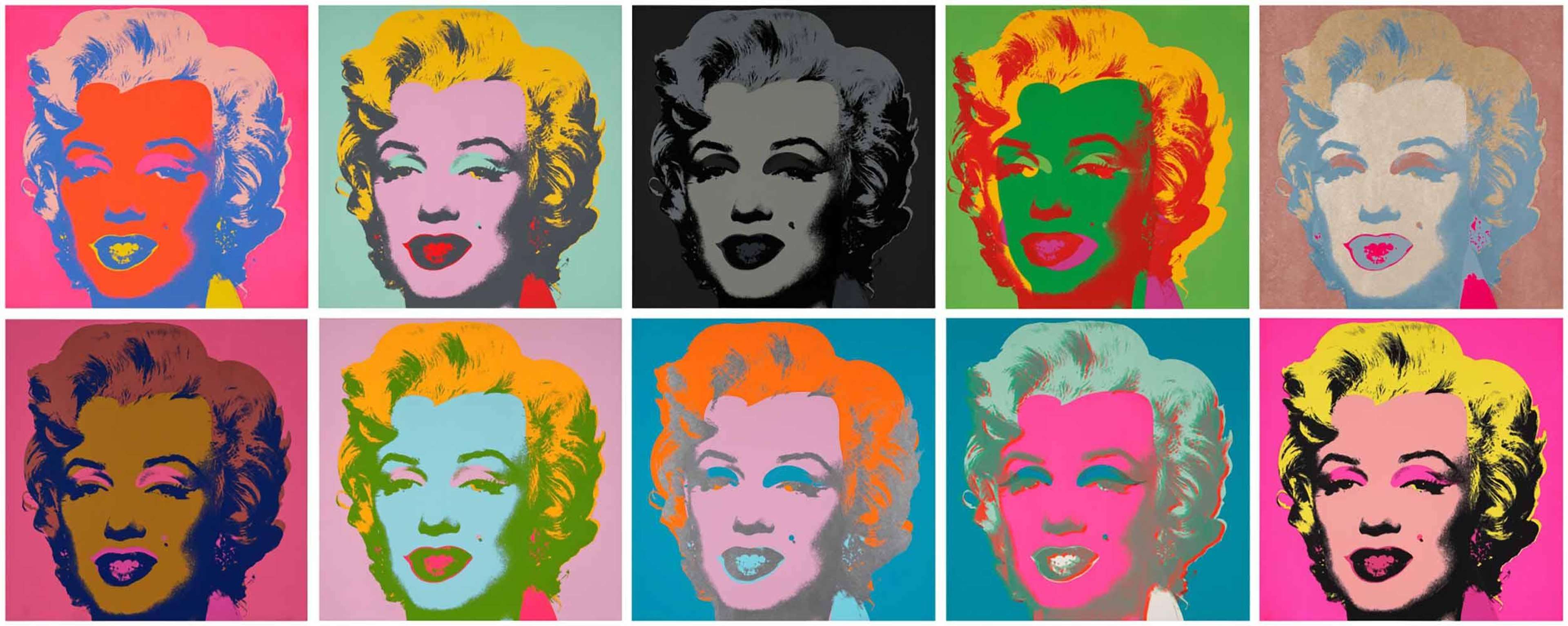
Marilyn (complete set)
Signed Print
Andy Warhol
91 x 91cm, Edition of 250, Screenprint, 1967
£2,830,000-£4,240,000
$5,330,000-$7,990,000 Market Value Indicator
$5,290,000-$7,920,000 Market Value Indicator
¥25,160,000-¥37,700,000 Market Value Indicator
€3,290,000-€4,930,000 Market Value Indicator
$29,410,000-$44,070,000 Market Value Indicator
¥593,660,000-¥889,450,000 Market Value Indicator
$3,750,000-$5,620,000 Market Value Indicator
There aren't enough data points on this work for a comprehensive result. Please speak to a specialist by making an enquiry.
Track auction value trend
Meaning & Analysis
Marilyn is a complete set of 10 screenprints made in 1967. Each print reproduces the same frontal portrait of Marilyn Monroe – based on a publicity photograph for the 1953 film Niagara – across ten colourways spanning hot pink and yellow, teal and orange, charcoal grey, and sage and gold. Each print is signed and numbered from an edition of 250.
The 1967 Marilyn portfolio is one of the most complete realisations of the principles that defined Warhol's practice. The source photograph – a publicity still from Niagara – had already been reproduced millions of times before Warhol encountered it. His contribution was to render those reproductions visible as a process, and to ask what colour does to a face that has been flattened into icon.
The 10 prints span an extraordinary chromatic range. The grey version – near-monochrome, the face barely distinguishable from the dark ground – is the set's most sombre statement, stripping the image of the glamour that every other variant supplies. Against it, the hot pink versions blaze with celebrity intensity; the teal variants render Marilyn cool and strange; the orange-haired version gives her a vitality that reads almost as disguise; the sand-ground variant, with its blue-grey hair, has an almost classical restraint.
Monroe died in August 1962, and Warhol began making her image almost immediately. The 1967 portfolio came five years after her death, by which point the image had already begun its long process of detachment from the woman. In Warhol's hands it became the clearest possible demonstration that celebrity, posthumous, is pure surface.