

A Market Re-Rating: Why Average Prices Are Climbing While Volume Holds Steady
Total annual sales value for Haring's print market peaked at roughly £4.6–4.7m in 2022–23, before cooling to £3.2–3.4m in 2024–25 as buyers grew more selective. Compared to the same period last year, every measure in H1 2026 is up: 67 lots sold against 62, total value up to £2.74m from £2.18m (+25%), and the average price per lot up 16% to £40,833 – the highest H1 figure in the ten-year period.
A market that cooled into 2024–25 is now showing more lots changing hands, at higher average prices, over the same six-month window than a year ago – a broader-based improvement than price strength alone. That tends to happen when buyers are competing more actively across the board, which is a favourable backdrop for anyone bringing a well-documented, well-preserved print to market this year.
Keith Haring’s Andy Mouse Prints Lead a Return to Scarcity-Driven Pricing
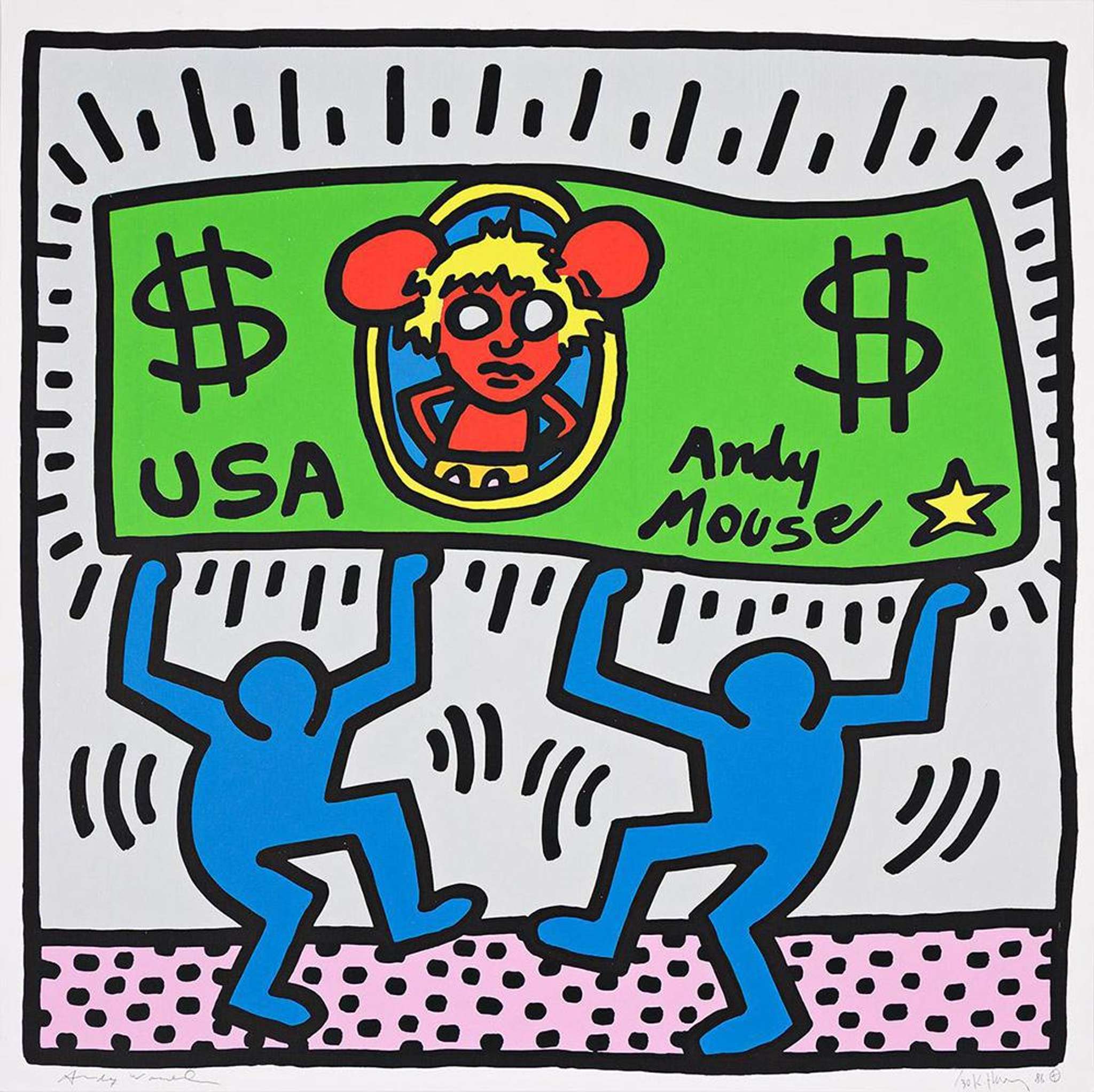
The clearest example of this shift is Haring’s Andy Mouse series. Haring's dual-signature collaboration with Andy Warhol – issued in an edition of 30 per colourway – all but disappeared from the auction record in 2024 and 2025, with only a single lot changing hands in each year. H1 2026 has already produced five Andy Mouse sales, averaging roughly £150,000, including a £206,000 artist's proof.
The swing from near-total absence to a five-lot cluster in six months says as much about demand as it does about supply. Andy Mouse's rarity has always been structural – only 30 examples exist per colourway, all bearing both artists' signatures. Scarcity alone, however, isn’t enough to support higher prices; buyers also need to compete for the work. H1 2026 suggests there is competition. For collectors considering selling a Haring Andy Mouse print, this has been one of the strongest-performing areas of the market so far in 2026.
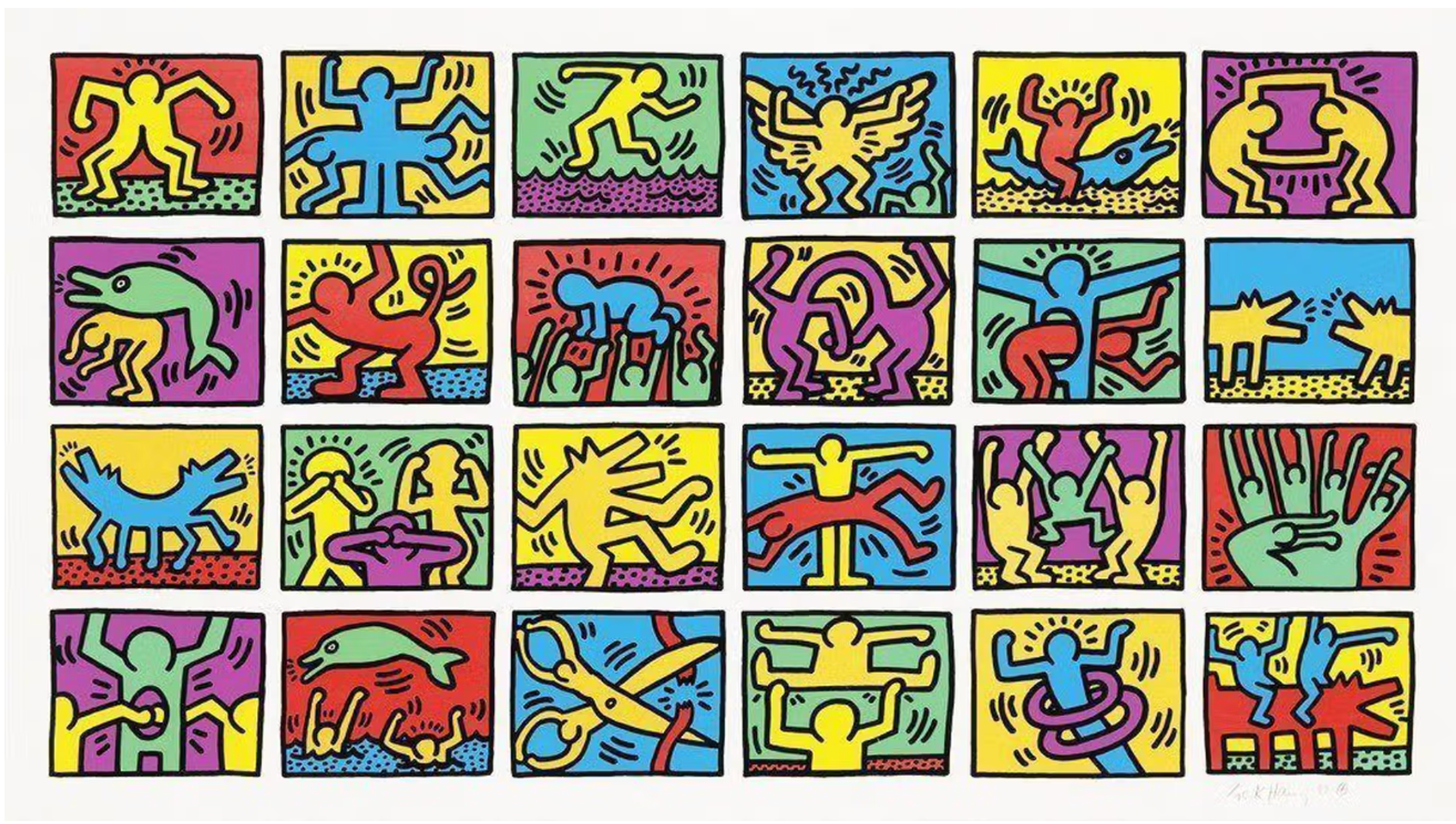
Andy Mouse isn't the only individual print showing this pattern. Retrospect (1989), one of Haring's most recognisable large-scale prints, sold for £99,505 in June 2026 – a rebound of nearly two-thirds on its 2024 low of £60,000, though still short of the £150,000–£180,000 range it commanded during its 2018–2020 peak. It's a partial recovery rather than a new high, but it points the same pattern as Andy Mouse: renewed buyer appetite for recognisable, well-documented individual prints, not just complete sets. Owners of Retrospect impressions – or comparable benchmark prints with a strong prior sales history – have a genuine case for revisiting the market now.
A New Name at the Top of the Market: The Blueprint Drawings
The single highest Haring lot of H1 2026 came from an unexpected place. A complete set from The Blueprint Drawings sold for £285,000 – a collection that has not previously featured among the year's ten highest lots from the last ten-year period. Whether this reflects renewed institutional attention, a single well-provenanced set finding the right buyer, or the beginning of a broader re-appraisal of the series isn't yet clear from one result. It is, however, a reminder that pricing benchmarks in Haring's market can shift quickly once a strong example is tested publicly – and that owners of lesser-traded series shouldn't assume a lack of recent auction history means a lack of demand.
Global Demand for Keith Haring Prints Is Broadening
One of the most significant developments in H1 2026 is where demand is coming from. In prior years, price gains have tended to be concentrated in a single region – the US in 2022–23, for example. H1 2026 shows average prices rising simultaneously across the US, UK, Europe and Asia, with Asia's average more than tripling on 2025's full-year figure.
For collectors considering where and how to sell, broad-based demand matters. A market with depth across multiple regions is less exposed to a single buyer pool softening, and gives a wider base of competitive bidding when a work is well-positioned.
Complete Sets vs Single Prints: Has the Set Premium Peaked?
Complete sets have driven much of the top end of Haring's print market in recent years, accounting for 8 of the 10 highest-value lots in 2025. H1 2026 tells a more mixed story: only 2 of the year's top 10 lots so far are complete sets, with individual rare prints – mainly Andy Mouse – reasserting themselves at the top of the market.
The two complete sets that did make this year's top 10 – The Blueprint Drawings (£285,000) and an Untitled 1 - 6 (set) from 1988 (£97,098) – are proof that sets still perform when they surface; although there haven't been as many of them in the first half of 2026.
It’s too early to call this a lasting shift. A single six-month period, particularly one with several high-value Andy Mouse sales, can alter the composition of the top end of the market. What it does show, however, is that the “complete set premium” isn’t fixed. In H1 2026, scarce individual prints outperformed complete portfolios, reminding sellers that rarity and buyer demand can outweigh format alone.
Keith Haring Dog Cutout Editions and Pop Shop Prints
At the rarest end of Haring's print market sit the painted Dog cutout editions – freestanding sculptural works that have appeared at auction only seven times in the past ten-year period. None traded in H1 2026, but the historical pattern is remarkably consistent: every recorded sale, regardless of colourway or year, has cleared between £241,000 and £488,000. Supply is exceptionally limited, and when these works do appear they have consistently achieved six-figure results.
Pop Shop continues to provide the market’s most consistent liquidity, with transparent pricing supported by a large number of comparable sales. The strongest price growth in H1 2026, however, came from scarcer works higher up the market. Its share of total lot volume this half (16%) sits toward the lower end of its typical 13–29% range, but the more useful point for sellers is structural rather than statistical: Pop Shop provides steady, comparable-driven demand for accessible works, while the real pricing momentum this half has come from the scarce tier above it. The two ends of the market are moving differently, and knowing which tier your print sits in matters more than ever.
What This Means If You're Considering Selling
Taken together, H1 2026 points to a market that is similar in volume but considerably stronger in price, with demand broadening across regions and reasserting itself around genuine scarcity – dual-signature prints, tightly-supplied portfolios, and sculptural editions in particular.
MyArtBroker's specialists can provide a complimentary valuation and advise on the right route to market – auction, private sale, or gallery placement – based on where your specific work sits within these current trends.
Data & Sources
This report draws on MyArtBroker's proprietary print market database, which tracks more than 400 auction houses worldwide. All prices are reported in GBP at hammer unless otherwise stated. This report is intended for research and information purposes only. Analysis is based on data available at the time of writing and may be subject to change. MyArtBroker accepts no liability for any decisions made on the basis of this information.