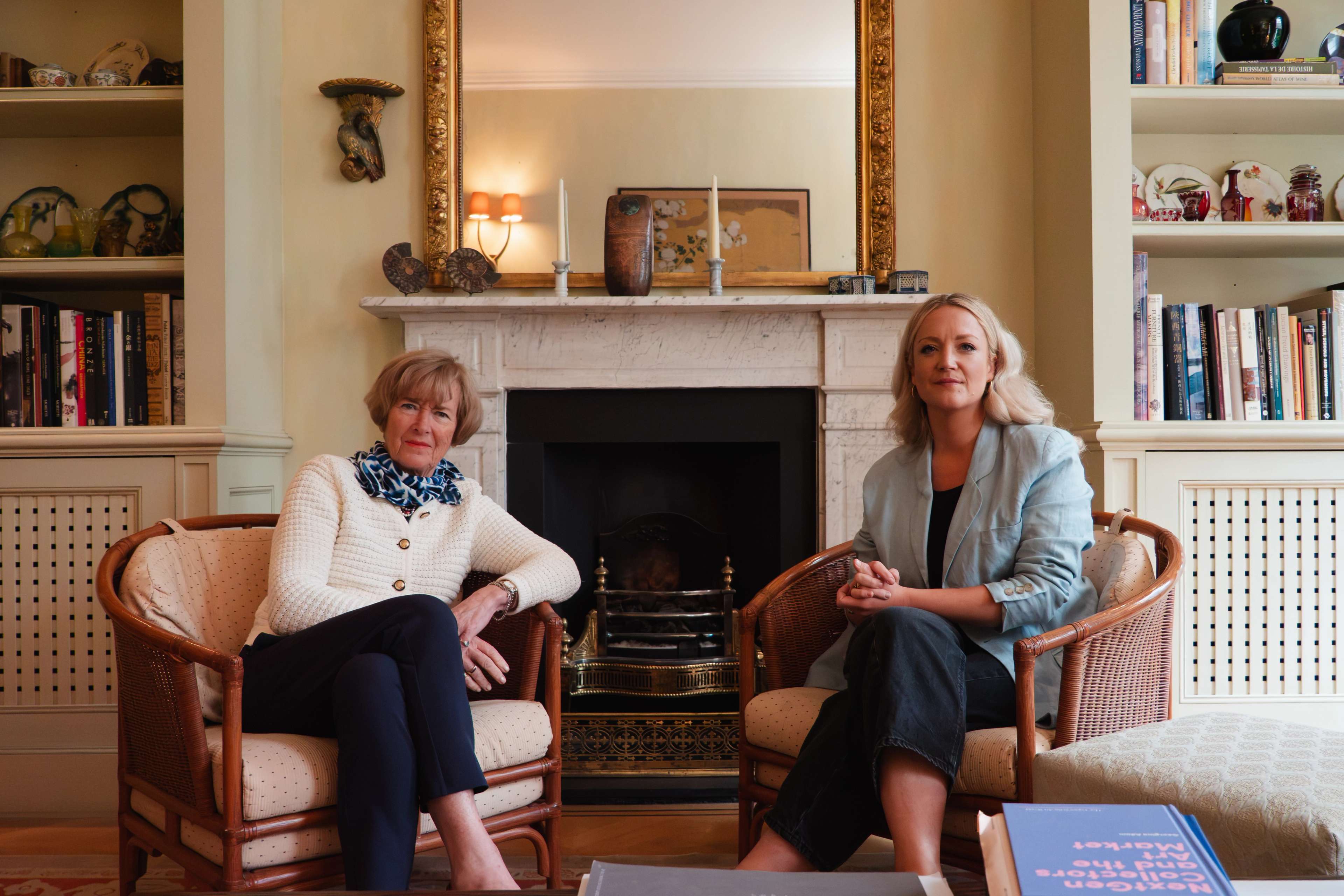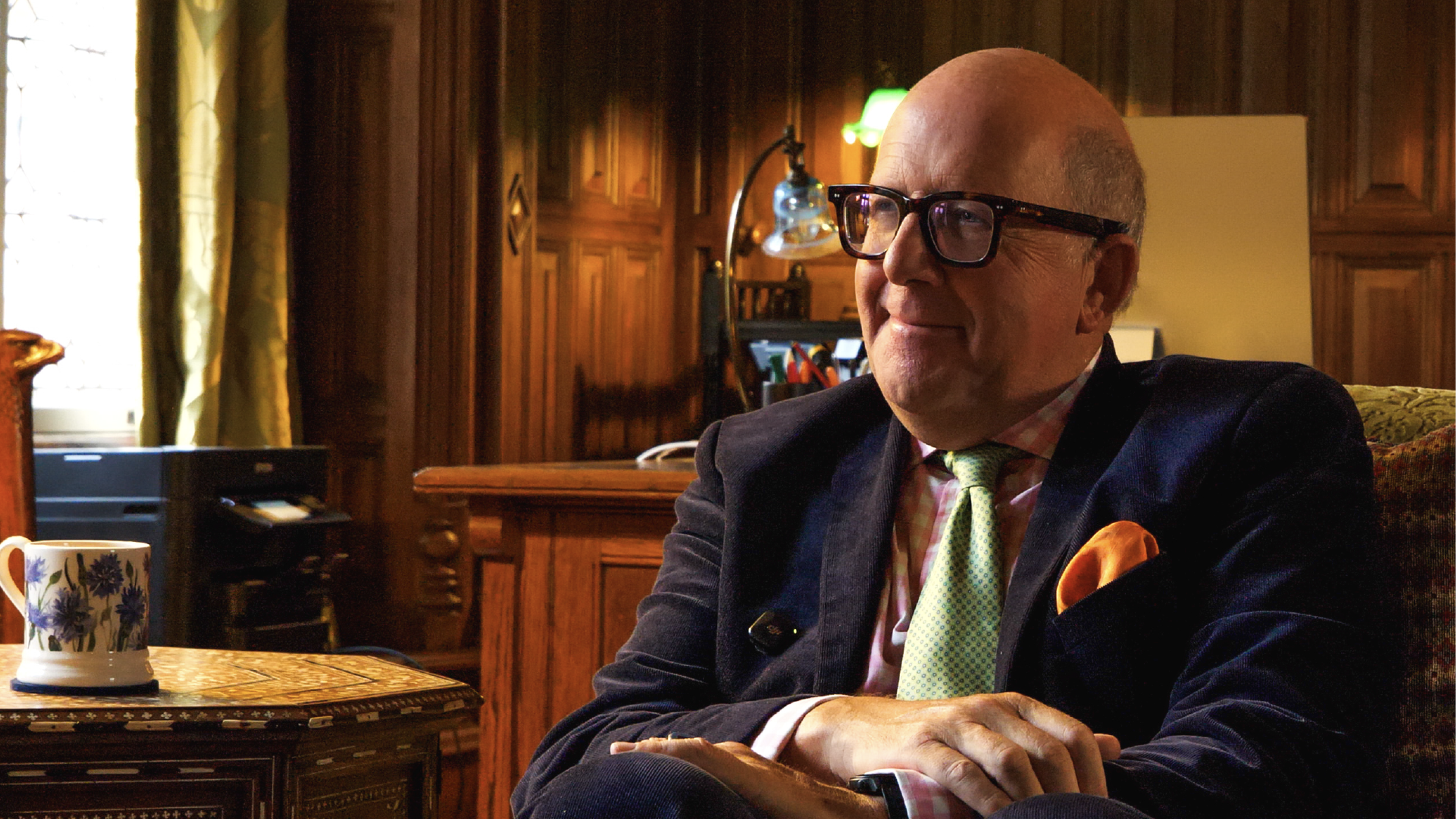
And then, as his friend and collector Ivor Braka, who generously lent us his home for our conversation, said to me as I arrived, “You know, of course, Philip knows nothing about art.”
It is the sort of comment that paints Hoffman as an outlier, but, as a close friend and confidant of so many experienced mega collectors. It also oddly flatters and explains him.
There is a version of Hoffman that circulates in the art industry, the maverick who arrived from finance and imposed discipline on an industry that preferred champagne to spreadsheets. The man who walked into a boardroom of “Old Etonians selling Rembrandts” as he remembers, and asked what the budget was.
That version is not wrong. But it is incomplete.
Because over the course of our conversation moving from his boarding school days and early times in Saudi Arabia to Christie’s politics and art-backed credit structures, something else becomes visible. The authority is undeniable and the confidence is real, and the refusal to indulge nonsense is deeply intact. But what sits underneath it is not arrogance. It is someone who has learned, sometimes painfully, what good business actually costs.
First Impressions & Absurd Inventions
Philip’s earliest encounter with art was not romantic. He remembers being dragged around the Fitzwilliam Museum in Cambridge by his mother, bored until he reached the armoury. Guns and swords were thrilling. Rembrandt was not. Paintings felt distant. Decorative. Slightly performative he tells me.
At seventeen he began collecting antiquarian books, volumes from the 16th, 17th and 18th centuries, drawn in by the illustrations, the paper, the feel of something that had survived. He then began collecting William Heath Robinson cartoons, the absurd contraptions that look like engineering but are, in truth, elaborate jokes. He and his brother bought around 50 originals paying around £100 each. They quietly assembled one of the largest Heath Robinson collections in existence.
It is telling that his first love in art was not painting, but systems disguised as absurdity. Heath Robinson’s machines never quite work. They are theatrical solutions to simple problems. Philip, as it turns out, would spend much of his life dismantling similar contraptions in the art world.
At school he was provocative. As he says: “If everyone went left, he went right”. He describes copying out a scholar’s A-plus essay in history and still receiving a C-minus. The teacher judged the student, not the work he explains.
That moment seems to have imprinted deeply on Hoffman. He learned that institutions often protect hierarchy before merit. That perception can override performance. So even at school he adapted quietly, until coming out with a punch. He secretly studied for three months, and came top in every subject. No announcement. No transformation narrative. Just outcome.
That combination, scepticism of authority and a willingness to master the structure beneath it, would go on to define him.
Hoffman wanted the stock market. He imagined top hats, lunches, glamour. His father insisted on accountancy. At KPMG he was eccentric. Bowler hat from Lock & Co. A sword-stick umbrella he had made personally for him. He hosted Pimms parties in lecture theatres during accountancy training sessions. He thinks perhaps he irritated senior partners.
And yet, he excelled. He was sent to Saudi Arabia at 20 years old to manage “petty cash.” Petty cash turned out to be $104 million. He audited Nestlé in Switzerland and earned money at 22 that would distort most young professionals’ sense of scale. He was made CFO of a shipping company at 23 after identifying major financial errors.
He learned that numbers are not abstract, and when Christie’s called in 1989, not because of art but because of financial chaos, and a predilection by KPMG to ‘relocate’ him, he walked in as CFO at 27 years old, under Christopher Davidge, with Lord Hindlip as chairman. He describes Christie’s as elegant, club-like, ritualised back in the late 80s. On his first day he was asked what he would like for lunch. Lobster, he said. “We’ll have lobster on Fridays.” they replied. Lunch began at noon and ended at four-thirty. Champagne bills ran into the hundreds of thousands annually.
He remembers presenting financial analysis while Lord Hindlip sat drawing a caricature of him instead of engaging. At the end of the meeting, Hindlip handed him the cartoon of Hoffman - a bubble above his head saying “the Hoffmanisation of the art market.”
It was humorous. It was also political. The implication was clear: numbers were intruding on culture. And yet, numbers were needed. Sotheby’s held 62% market share. Christie’s held just 38%. Within a few years, that became 52% to 48% under Davidge’s team and Hoffman’s leadership.
Philip introduced budgets to departments that did not understand the word. “What the hell’s a budget?” he recalls being asked. He introduced targets. He introduced deal-making. He cut £3–6 million in costs within twelve months, excluding payroll.
When he examined the champagne bill and suggested slashing it, Lord Hindlip reportedly told him, “The day we stop serving champagne at Christie’s, I leave.” Champagne stayed. Philip learned quickly that reform requires calibration. He was commercially ruthless, and by his own admission somewhat socially naive. He even admits he may very likely have been a ‘a bit of a shit’.
However, considering all this, it’s clear to me when listening to him, that the defining moment of his Christie’s years was not the market share success of a ruthless young businessman. It was the redundancies. At 29, he was tasked with implementing 60 layoffs during a recession. He had to tell seasoned professionals their careers were over. His tone changes, as he tells me "It’s my biggest regret,”. He believes Davidge should have done it himself. Instead, the youngest executive in the room carried the emotional burden. The market remembers the turnaround. He remembers the conversations with 60-year-old employees whose family’s livelihoods were held in the brink of his decisions, and their 30+ year careers. That experience reshaped him. Because from that point onward, his reforms were not only about numbers. They were about sustainability and while he never coins this phrase directly - they were about people management.
When he proposed launching an art investment fund inside Christie’s, Lord Hindlip rejected it outright. “Over my dead body.” Of course, that rejection became catalytic. Philip left Christie’s at 39, was paid not to work, negotiated the restriction down to a year, and travelled the world with his wife and children. Then on 1 January 2001, he sat down with pencil and paper and began constructing what would become The Fine Art Group.
Building The Fine Art Group
He started by building credibility. Hoffman cold-called Bruno Schroder, referencing Jacob Rothschild and Lord Gowrie within the first thirty seconds. The next morning, when Schroder called him out - “Rothschild doesn’t know who you are” - Philip recovered just as quickly, steadying the room and turning the meeting in his favour. It was early evidence of what would become a defining trait: nerve, calibrated by preparation.
He recruited and collaborated with senior figures including Katrin Henkel, Lord Gowrie and pension fund leadership from Canada. He understood instinctively that if you wanted institutional capital to take art seriously, you had to build institutional architecture around it. He targeted to raise $350 million and launched his first fund. And then he iterated. Blue-chip funds. Chinese and Middle Eastern strategy funds. Auction guarantee structures. Art-secured lending.
He briefly partnered with Dresdner Kleinwort Wasserstein Bank, which bought 50% of the business. That ended when their compliance team queried a Heathrow coffee expense. That moment, small as it sounds, crystallised something fundamental. Philip is not built to be second-guessed by bureaucracy. He split the business and continued independently.
Today, The Fine Art Group operates globally, advising ultra-high-net-worth collectors, family offices, sovereign wealth structures and major private banks. It has structured nine funds. It has lent hundreds of millions against art assets. It competes directly with Christie’s and Sotheby’s private sales. It collaborates with operators such as Patti Wong, Gorvy and Dolman.
But its defining feature is independence. It does not need theatre. It does not need to justify 30% transaction spreads. It does not need to feed vast real estate footprints. It operates as an advisory nucleus. Where auction houses are transaction-led and galleries inventory-led, The Fine Art Group is client-led. Philip believes that distinction matters more now than ever.
He is sceptical of online platform hype. He has watched tens and hundreds of millions burn in “disruption.” He believes the top end remains human. Negotiated. Structured. Specialist.
He tells the story of a client who thought he had secured a $6 million Monet bargain. The painting had been previously damaged, paid out on insurance, invisibly restored and commercially compromised. Without expert scrutiny, $6 million vanished. He speaks bluntly about art investment marketing, misleading graphs, cherry-picked returns and cowboy operators.
Art is not a bad investment, he insists. It is a complex one. And most people do not know the rules. At the end of our conversation, I ask what he would do if he walked back into an auction house as CEO. He answers immediately. Cut headcount. Cut real estate. Focus on elite operators. Franchise the rest.
It sounds radical. It is also precisely how he built The Fine Art Group - lean, strategic, independent.
People call him a maverick. But he strikes me as a clear-eyed businessman who has always been structured. Even as a rebellious schoolboy. Even in a bowler hat at KPMG. Even in a Christie’s boardroom dominated by tradition.
Hoffman sees systems. He sees incentives. He sees where value is created and where it leaks away. And somewhere between firing 60 people at 29 years old, and advising billionaires not to overpay - or as Hoffman has quipped “advising clients against purchases 90% of the time” - a reflection of his commitment to disciplined judgment over transaction volume - the Hoffman edge has matured into razor sharp judgement. Philip Hoffman did not fall in love with the art world, like so many of us. He respected it enough to professionalise it. And in doing so, he built a firm that now sits quietly at the centre of its most serious conversations, where art stops being theatre, and starts being structured sense-making business.