
Key Takeaways
How to Sell a Bridget Riley Print
- Identify whether your work is early black-and-white or mid-to-late colour – period influences demand
- Assess condition rigorously – paper tone, margins, and colour integrity are critical
- Confirm edition size and publisher alignment before approaching buyers
- Consider whether private placement offers stronger positioning than auction exposure
- Align presentation with Riley’s recognised optical language and institutional standing
Condition and period matter more than volume, and strong impressions are increasingly absorbed into private collections. This guide outlines how Riley’s market functions in 2026 and what sellers should evaluate before introducing a work for sale.
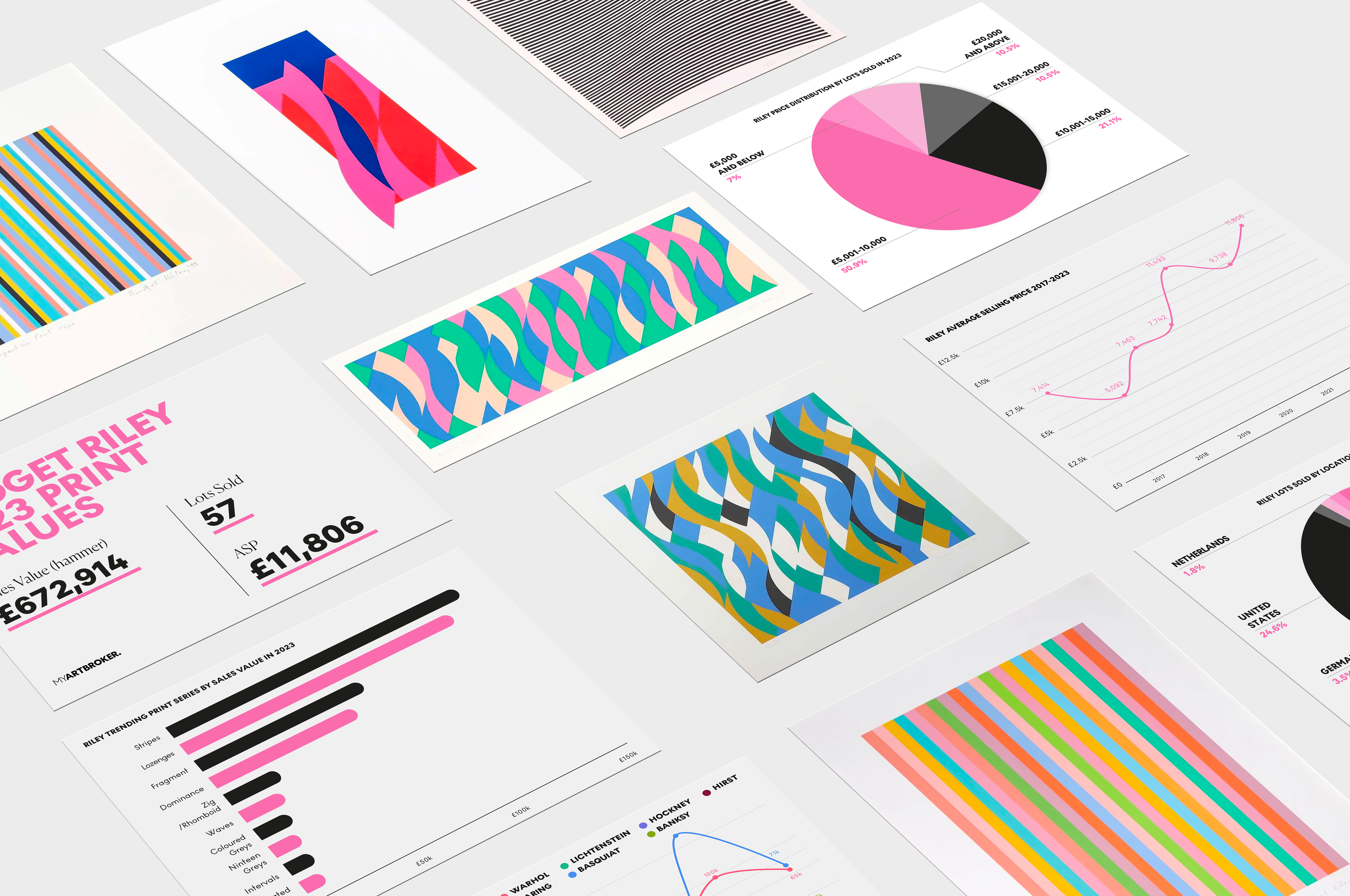
The charts in this article reflect live data that updates continuously as sales occur throughout the year across more than 400 global auction houses. As a result, the figures displayed in the charts may occasionally differ from those referenced in the text.
Is Now a Good Time to Sell a Bridget Riley Print?
Riley’s print market in 2025 is stable, but increasingly differentiated by imagery and condition.
Public sales data shows that early black-and-white works have moderated from previous peaks. This shift reflects heightened condition sensitivity, although demand for strong impressions in excellent condition remains intact.
At the same time, collector focus has consolidated around Riley’s mid-career and later colour works – compositions that generate optical movement through rhythm and pattern, particularly coloured stripe-based formats. These works align closely with her most recognisable visual language and have demonstrated steadier performance in recent cycles.
Sellers holding well-preserved examples within Riley’s most sought-after visual systems remain well positioned in a functioning but selective market.
Bridget Riley Print Market In 2025 – What’s Driving Value?
Over the past decade, sustained exhibition activity has reinforced Riley’s art-historical position and institutional weight. This includes the major retrospective at the Hayward Gallery (2019), Bridget Riley: Drawings at the Hammer Museum in Los Angeles (2023), her ceiling commission at the British School at Rome (2023), and her most recent major exhibition at Turner Contemporary in November 2025. Such institutional visibility consolidates confidence in her work across both primary and secondary markets.
Scarcity is equally significant. Riley’s original paintings are tightly held and rarely come to market. Her print production, while more accessible, is not expansive relative to many of her blue chip contemporaries. This increasingly limited supply continues to support structural demand.
What Drives Bridget Riley Print Value For Sellers
Riley’s market rewards clarity of positioning. Works that sit firmly within her core optical language – and are well preserved – benefit from institutional momentum and structural scarcity. Performance is shaped by how convincingly an edition aligns with her recognised visual legacy, rather than by short-term market movement.
How Much Is My Bridget Riley Print Worth?
Valuation in Riley’s print market is driven by period, edition size, condition, and visual system rather than by volume or short-term momentum.
Black and White Bridget Riley Print Value
Early black-and-white works historically set the benchmark for Riley’s print market. While overall values have moderated from peak levels, demand remains concentrated in rare, well-preserved examples.
Value in these works is tied to both material and scarcity. Certain editions, such as the Fragment series printed on Perspex, are technically distinctive and comparatively difficult to source in strong condition. Later untitled black-and-white works printed on paper – including Untitled (Oval), which set the auction record at Phillips in 2024 – are similarly scarce in exceptional state.
Because these editions were produced in small numbers and are increasingly difficult to find without surface compromise, rarity and preservation continue to anchor pricing strength.
Bridget Riley Colour Prints Value
Mid-career and later colour works – particularly Lozenges, Stripes, and Waves – have shown steadier performance in recent cycles. These rhythm-driven compositions generate optical movement through structured colour sequencing and pattern repetition.
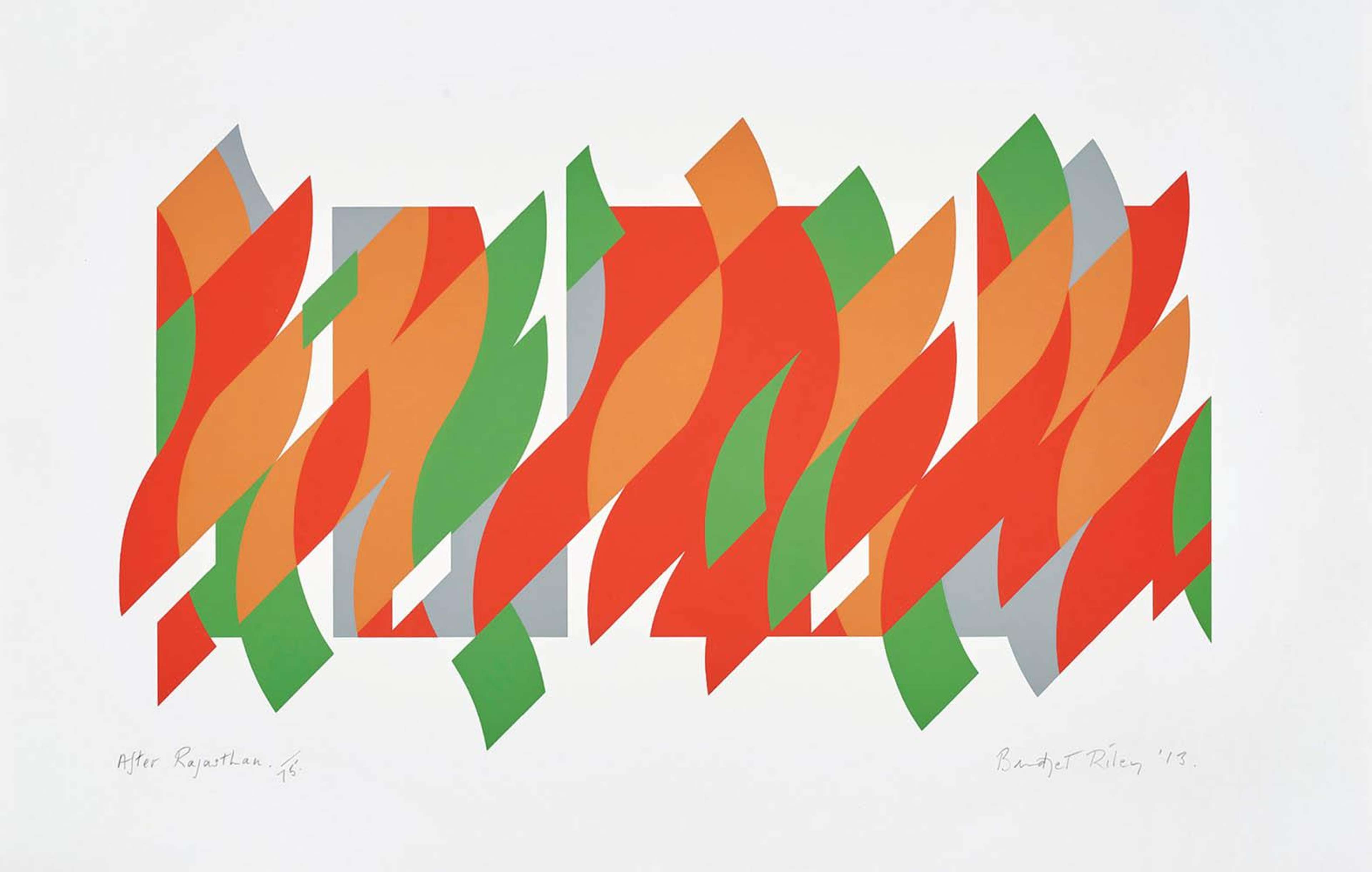
Works from Riley’s post-Egypt period, where her palette shifted towards warmer desert tones and expanded chromatic contrast, are especially sought after. This evolution marked a decisive moment in her printmaking and continues to underpin demand for later colour editions aligned with her most recognisable visual language.
Bridget Riley Edition Size and Print Value
Edition size plays a material role in pricing. Riley’s editions are generally smaller than many of her peers, with rare or early works sometimes issued in editions of 5–20, while many signed screenprints are produced in or under editions of 100.
Because her overall print output is finite and tightly held, supply is naturally constrained. Complete sets are uncommon, and when intact groupings appear, configuration can materially influence outcome.
Across all periods, condition remains central. Riley’s precision-based compositions tolerate little surface compromise. Two impressions from the same edition can perform differently depending on preservation, margin integrity, and colour clarity.
How to Authenticate a Bridget Riley Print Before Selling
Authentication in Riley’s print market is documentation-led and relies on correct signature, edition alignment, publisher records, and catalogue references.
Bridget Riley Signature & Edition Numbering
Most Riley prints are signed and numbered in pencil, typically in the lower margin. The signature should be consistent with known examples from the relevant period in terms of placement, handwriting style, and pencil application.
Edition numbers must correspond precisely with the documented edition size – often under 100, and in early cases as few as 5–20 impressions. Discrepancies in numbering format or placement can affect buyer confidence and resale strength.
Because Riley’s prints were conceived as original works for printmaking rather than reproductions, confirming accurate title, date, edition size, and signature alignment is essential before sale.
Bridget Riley Publisher, provenance & Catalogue Raisonné
Key publishers include Kelpra Studio, Curwen Studio, Petersburg Press, and later specialist workshops. Verifying the publishing studio and retaining proof of purchase, prior auction history, or gallery documentation materially strengthens buyer confidence.
The principal reference for her editions is Bridget Riley: The Complete Prints 1962–2020. Confirming that your work aligns with its catalogue entry – including title, year, publisher, and edition size – is an important verification step that a specialist can assist with.
There is no active Bridget Riley authentication committee. Provenance and catalogue alignment therefore form the foundation of resale assurance.
How to Conserve Your Bridget Riley Print to Retain Value
Condition is particularly sensitive in Riley’s market because her work depends on optical precision and surface clarity.
Bridget Riley Print Condition – Paper-Based Works
Many early black-and-white Riley prints were produced on bright white paper that is prone to toning over time. Even slight yellowing, foxing, or uneven ageing can materially affect visual sharpness and resale value.
Margins should remain full and untrimmed. Acidic mounts or backing boards can cause long-term staining. UV-protective glazing and stable humidity are essential to preserve paper-based prints.
Bridget Riley Fragment Prints on Perspex – Surface Condition
Riley’s Fragment works were produced on Perspex rather than paper. Surface scratching, scuffs, clouding, or edge damage can materially affect value. Because these works rely on clarity and reflective interaction with light, even minor surface abrasion can disrupt their optical effect.
Fragment prints should be handled carefully and cleaned only by professionals experienced with acrylic materials.
Colour Fading and Condition in Bridget Riley Screenprints
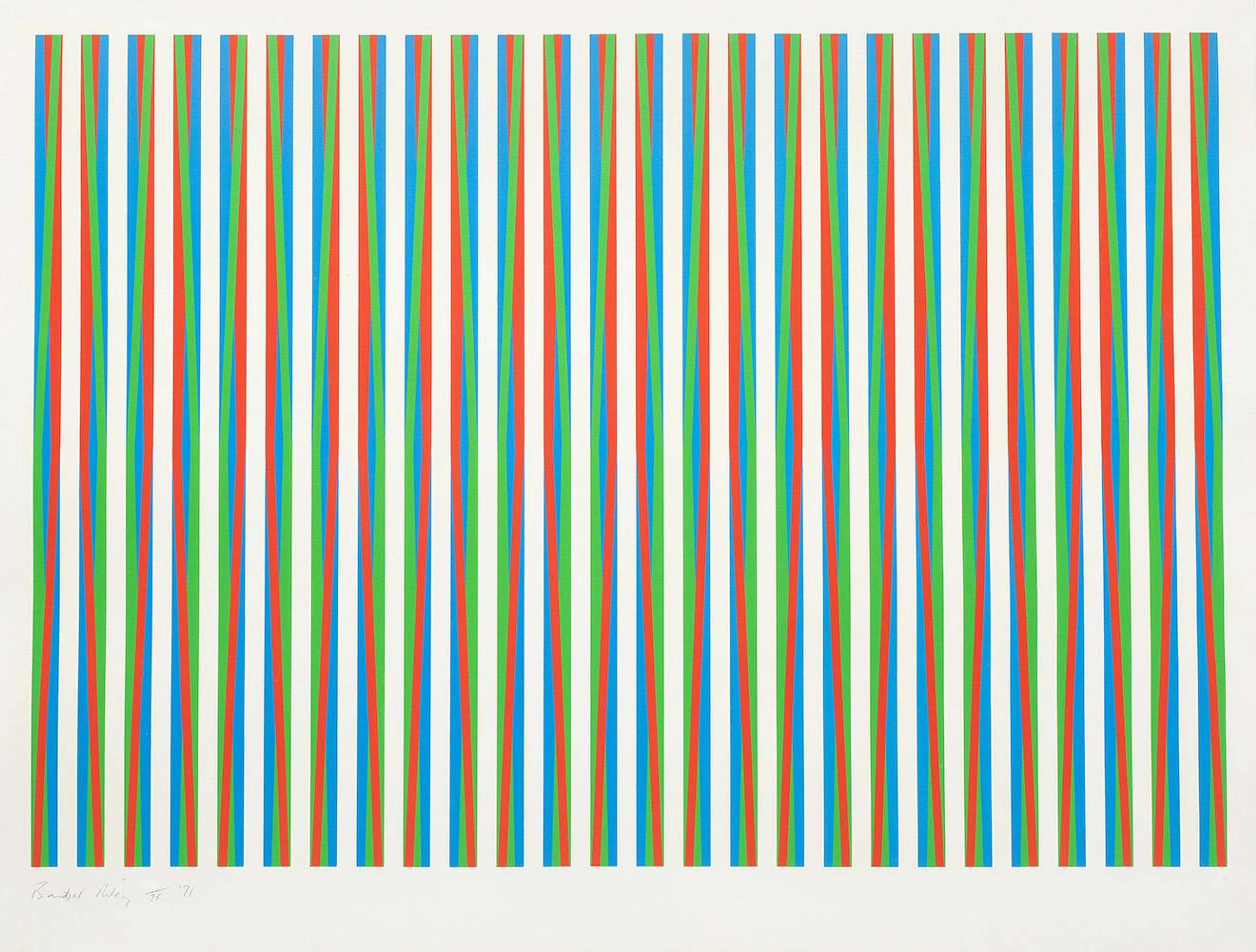
In later colour screenprints, saturation and registration are critical to value. UV exposure can cause fading that flattens stripe- or wave-based compositions. Misregistration, abrasions, or surface disturbance interrupt the visual movement central to Riley’s work.
Professional conservation should always be documented. Over-cleaning or undocumented restoration can reduce resale strength.
Well-preserved Riley prints – whether on paper or Perspex – are increasingly scarce, and condition directly influences pricing and placement.
Where Can I Sell My Bridget Riley Print?
Choosing where to sell a Riley print directly affects pricing risk and net return. In a selective market with limited annual auction volume, route to sale matters.
Auction vs Private Sale – Fees & Risks
Selling a Riley print at auction offers public visibility, but it also carries risk. Seller’s commission, buyer’s premiums, and published estimates can reduce flexibility, and if a work fails to sell, the buy-in can potentially impacting future value perception.
Private sale reduces exposure risk. Prints are introduced directly to qualified buyers, offering greater pricing control and discretion – particularly for rare or condition-sensitive works.
For a detailed comparison of auction fees, seller’s commission, and risk exposure, see our guide to auction vs private sale for art prints.
Why Sell Your Bridget Riley Print With MyArtBroker
Selling a Riley print requires accurate valuation, strategic pricing, and access to qualified buyers. As a specialist platform for blue chip prints, we provide data-driven Riley print valuations and structured private sale placement designed to maximise net return.
Bridget Riley Print Valuation and Instant Price Estimate
We combine specialist expertise with live auction data to provide accurate print valuations. Sellers can begin with our Instant Valuation tool to receive an immediate price estimate, supported by current market comparables and demand signals.
Sell Your Bridget Riley Print with 0% Seller’s Fees
We operate on a private sale model with 0% seller’s commission. Unlike auction houses, there are no public estimates and no seller fees deducted from your final result, helping protect your net proceeds.
Access Active Buyers Through Our Trading Floor
Through our live Trading Floor, we identify collectors actively seeking Riley prints and introduce works directly to qualified buyers. This targeted approach avoids unnecessary exposure while improving match quality and negotiation strength.
Specialist Advisory and Strategic Placement
Each Riley print is positioned according to period, edition size, condition, and market demand. If auction or alternative placement would deliver a stronger outcome, we provide impartial guidance based on current supply and buyer behaviour. Get in touch with our specialists to speak about your Riley print.