

Key Takeaways
A new Banksy sculpture has appeared in London's Waterloo Place, St James's – confirmed by the artist on Instagram. It won't be there long.
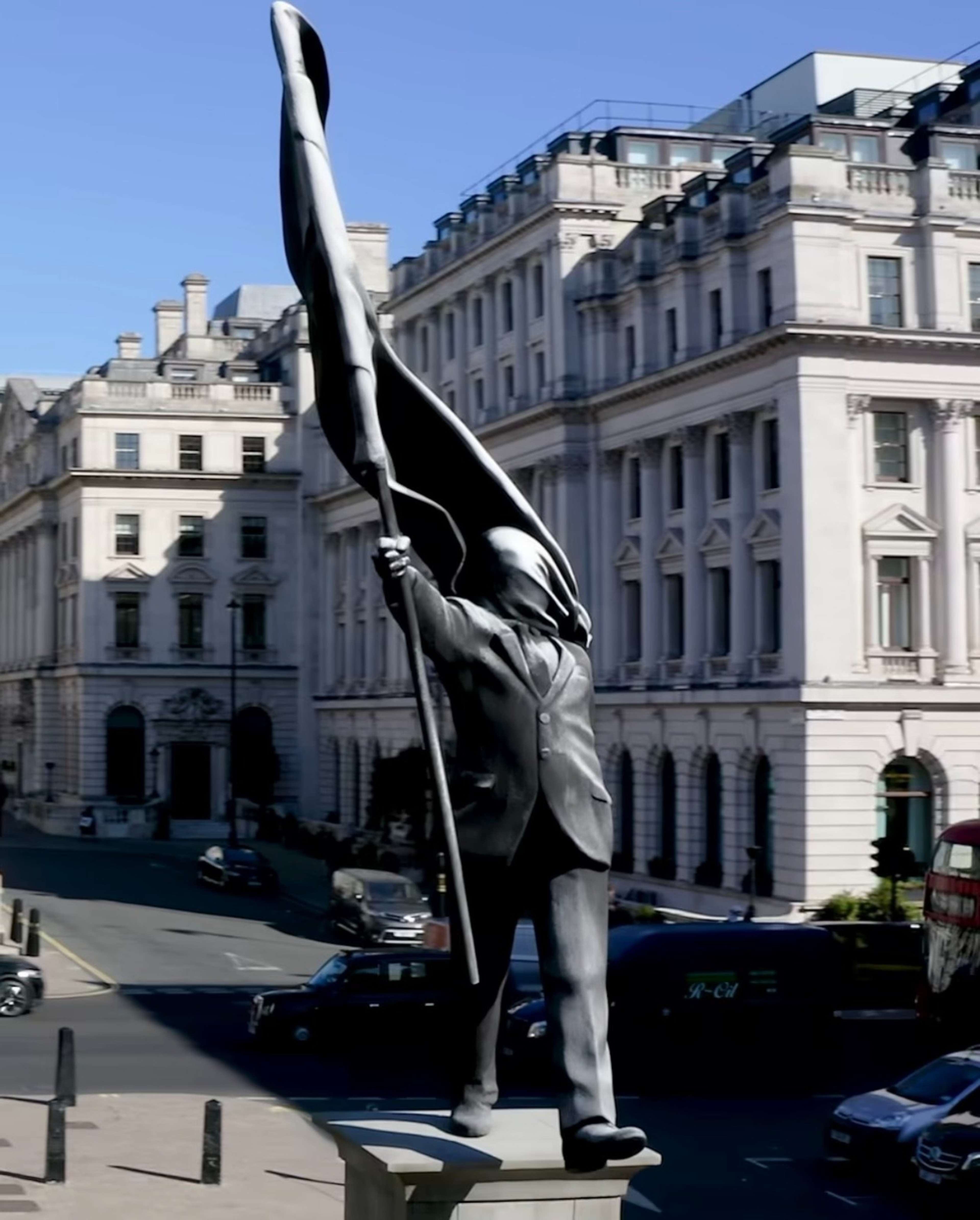
The work depicts a suited man stepping forward from a plinth, his face entirely obscured by an oversized flag. Signed on the base, the figure appears frozen in the split second before a fall – one foot already beyond the edge.
It is the latest in a string of public interventions from the artist, following Banksy's London Zoo murals and the Justice Courts. But where those leaned into Banksy's signature stencil work, this marks a departure – a full sculptural installation placed among some of London's most historic monuments.
At first glance, the piece carries Banksy's familiar strain of physical comedy: a figure caught in an almost slapstick misstep. But as ever, the humour quickly gives way to something more pointed. This is authority rendered blind – so consumed by its own symbols that it can no longer see where it is going.
The work has already been boxed off, and given the pattern of Banksy's public installations, it is unlikely to remain in situ for long.
Banksy's Waterloo Place Location and Its Political Symbolism
Waterloo Place was conceived in the early nineteenth century to commemorate victory over Napoleon. It forms a grand, processional extension of Regent Street, framed by statues of imperial figures and military leaders – the Duke of York Column, the equestrian statue of Edward VII, the Crimean War Memorial. It sits within walking distance of Westminster and is encircled by institutions synonymous with Britain's political establishment.
Banksy has adopted the visual language of these monuments – the plinth, the suit, the forward stride – only to subvert it through imbalance and uncertainty. Where every other figure in Waterloo Place stands with permanence and composure, Banksy's is about to fall. The flag, typically a symbol of purpose and identity, becomes the very thing that prevents his subject from seeing clearly. Forward motion, usually read as progress, becomes risk.
It is a deceptively simple composition. But placed within that particular constellation of bronze worthies, it becomes difficult to read as anything other than a commentary on blind authority – leadership that marches forward without understanding where it is headed.
Banksy Print Market and Record Auction Sales in 2026
This intervention comes at a moment when Banksy's print market has demonstrated new record-breaking results at auction. And of course, the work itself resists all of that – no auction house, no edition number, no price tag – just a loaded image placed in a public space, free and unsigned in any commercial sense. It is a pointed reminder that Banksy's practice has always operated on two tracks – one that feeds the market, and one that deliberately sidesteps it.
For collectors, these moments tend to matter. Major public interventions – particularly ones that generate this level of media coverage – have historically correlated with upticks in print demand and renewed buyer interest across Banksy's editions. Whether or not it shifts pricing directly, it recharges the cultural relevance that underpins his market.
Banksy's Identity Investigations and What This Work Really Says
This also arrives after years of ceaseless – and ultimately failed – attempts to identify the artist, most recently Reuters' investigation in March 2026, which claimed to have traced Banksy through court records and historic police documents. It was widely framed as a breakthrough. In reality, it felt like the latest instalment in a decades-long media fixation that continues to miss the point.
The Waterloo Place sculpture quietly reinforces that. Its central figure is faceless, anonymous, defined not by identity but by position – elevated, yet unstable. Banksy doesn't engage with the speculation. He simply puts another work into the world and lets it speak for itself.
After the headlines, the investigations, and the record prices, this piece strips everything back. It's a reminder that with Banksy, it has always been about the art.